
Before anyone reads your reviews, visits your website, or talks to your staff, they see your sign. It works every hour of every day, in the rain, without a paycheck. For a lot of Pacific Northwest businesses, it is the single most-seen piece of marketing they own.
In a year when every dollar is getting a harder look, it is fair to ask: is a custom sign worth it? Here is what the numbers say, what is happening in our regional economy, and how the right sign does more than announce your name. It tells the right people that you are exactly who they have been looking for.
The PNW business climate: customers are choosier
The Northwest economy in fall 2026 is steady but tight. Washington's state forecasters expect just 0.2% job growth this year, with unemployment near 5.1% and Seattle-area inflation around 4.1% (WA ERFC, Sept 2026). After inflation, Washington household income is forecast to grow only about 0.5% in 2026 before picking up in 2027.
Oregon tells a similar story. The state's economists call it a "low hire, low fire" economy with inflation running above target for more than five years, driven by tariffs, energy, shelter and wages (Oregon OEA, Sept 2026).
What that means on Main Street:
- Shoppers are spending carefully. With little real income growth, people pick fewer places and stick with the ones they trust.
- Costs are up for you too. Rent, labor and materials all cost more, so every marketing dollar needs to keep earning.
- New buildings are filling in. Multifamily construction is rising in Washington, which means new neighbors who have not picked their coffee shop, dentist or mechanic yet.
In a cautious market, the businesses that win are the ones that are easy to find, easy to understand and easy to trust at first glance. That is a sign's whole job.
Signage ROI: a one-time cost that keeps paying
According to the International Sign Association, businesses report an average sales increase of 10% when a sign is added, replaced or updated (ISA, Buying a Sign). Researchers at the University of Cincinnati have studied the same question and found that a sign's legibility, quality and uniqueness are tied directly to a business's financial results (Sign Research Foundation).
The reason is simple. Most advertising stops working the day you stop paying for it. A well-built sign keeps working for years.
Here is an easy way to think about the math for your own business:
- Find your profit per new customer. Average sale x your margin. A $40 average ticket at a 30% margin is $12.
- Find your break-even. Sign cost / profit per new customer = the number of new customers you need to pay it off.
- Spread it over the sign's life. Divide the cost by the days it will hang. Over 10 years, that is 3,650 days of advertising.
Most owners are surprised how few extra customers it takes. And unlike a social ad, those customers keep coming after the first year, because the sign is still there.
If the up-front cost is the hurdle, financing can spread it out so the sign starts paying for itself right away. We walk through the options in How to Buy Signs Part 6: Sign Financing Options.
Put your personality on the wall
University of Cincinnati researcher Dr. James Kellaris put it plainly: consumers learn, and assume, all sorts of things about a business based on its sign (Sign Research Foundation). Your sign is going to say something about you either way. A custom sign lets you choose what.
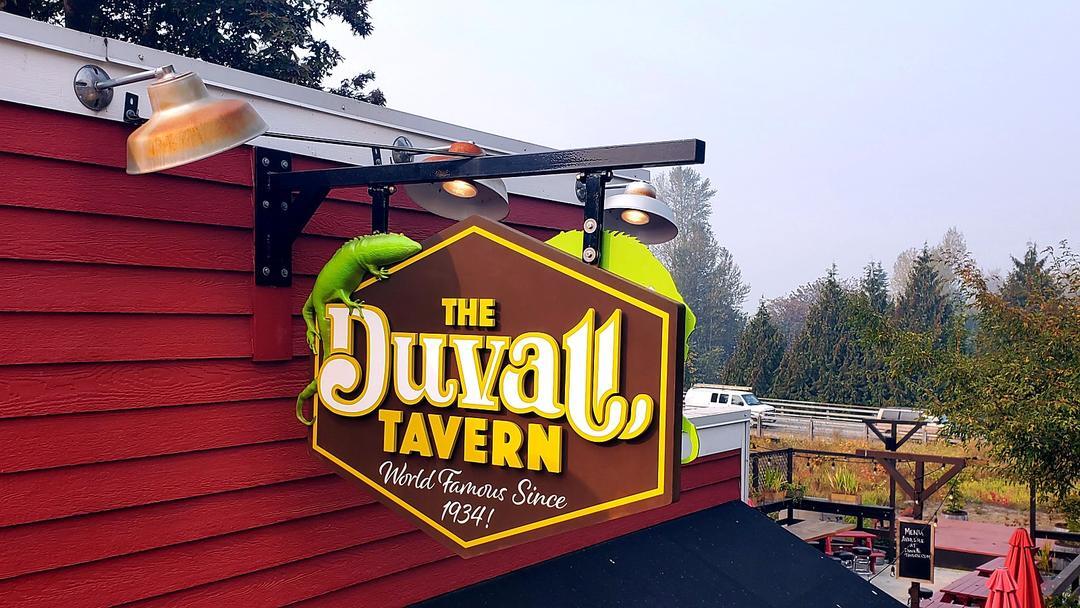
The Northwest is full of businesses with real character: the family bakery, the brewery in a converted garage, the outdoor shop run by people who actually climb. A stock box sign hides all of that. A custom sign shows it.
Ways your sign can carry your personality:
- Materials. Reclaimed cedar, raw steel and stone feel rugged and local. Brushed aluminum and acrylic feel clean and modern. Painted wood feels hand-made and friendly.
- Lighting. Warm halo-lit letters say "come in and relax." Bright, crisp LED says "fast and efficient." Neon (or LED neon) says "fun."
- Shape and dimension. A cut-out silhouette, a hanging blade sign or 3D letters give people something to remember and photograph.
- Color and type. Your brand colors and fonts, used consistently from the sign to your website to your business cards, make you instantly recognizable.
- Story. A nod to your town, your history or your craft gives locals a reason to feel like you belong here.
One caution: your personality has to work for your customers, not just for you. A beautiful sign nobody can read from the road is still a bad sign. We dig into that balance in How to Buy Signs Part 2: The Most Effective Sign Is Not Necessarily the Most Expensive.
Attract the right customer, not just more customers
The goal is not to get everyone through the door. It is to get the people who will love what you do, spend well and come back. Your sign is a filter as much as a magnet.
Think of it this way. A high-end salon and a quick-cut barbershop can sit on the same block. If their signs look the same, both waste time on customers who expected something else. When each sign clearly says what kind of place it is, the right people walk in and the wrong ones keep walking. Nobody is disappointed.
Start with your ideal customer:
- Who are they? Families, young professionals, contractors, retirees, tourists?
- What do they value? Price, speed, craftsmanship, sustainability, luxury, convenience?
- How do they arrive? Driving 45 mph down an arterial, walking a downtown sidewalk, or searching a business park?
Those answers shape the design. A value-focused business wants bold, simple and readable from the road. A premium brand can use restraint, fine materials and space. A business serving drivers needs larger letters and high contrast; one serving pedestrians can afford detail and charm. (More on designing around your audience in How to Buy Signs Part 3: Sign Design, The Big Picture.)
When your sign matches the customer you want, every person it pulls in is more likely to become a regular. That is where the real return comes from.
Making the investment count
A few things separate a sign that pays for itself from one that just hangs there:
- Legibility first. If people cannot read it at the speed they pass, nothing else matters. Size letters for the street, not the sidewalk in front of you.
- Light it. Our winters are long and dark. A sign that disappears at 4:30 p.m. in December is missing a big share of its audience.
- Build for Northwest weather. Rain, moss, salt air and UV all take a toll. Quality materials and finishes protect your investment and your image.
- Plan for permits. Every city and county has its own sign code. A good sign partner handles the paperwork so your install date does not slip.
- Keep it consistent. Your sign, storefront, vehicles and website should look like one brand.
- Keep it clean. A faded or broken sign tells customers you have stopped paying attention. Regular maintenance protects the impression you worked to create.
Let's build a sign that sounds like you
Right now, customers are choosy about where they spend. They go where they feel welcome and where they can tell at a glance what you're about. A custom sign tells that story for you, every day, for years.
At Northwest Sign & Design, we start with your story and your ideal customer, then design, build and install a sign made for our weather and your street. Ready to talk about yours? Contact us for a free consultation.